Khelo India Scheme 2026–31: ₹29,054 Crore Approved
Published on Aug 23, 20265 min readBy The Bharat 2030 CWG Team
Govt notifies the revamped Khelo India Scheme for 2026-31 with a ₹29,054 crore outlay across nine components. Here's what it covers.
Government Notifies ₹29,054 Crore Khelo India Scheme for 2026–31
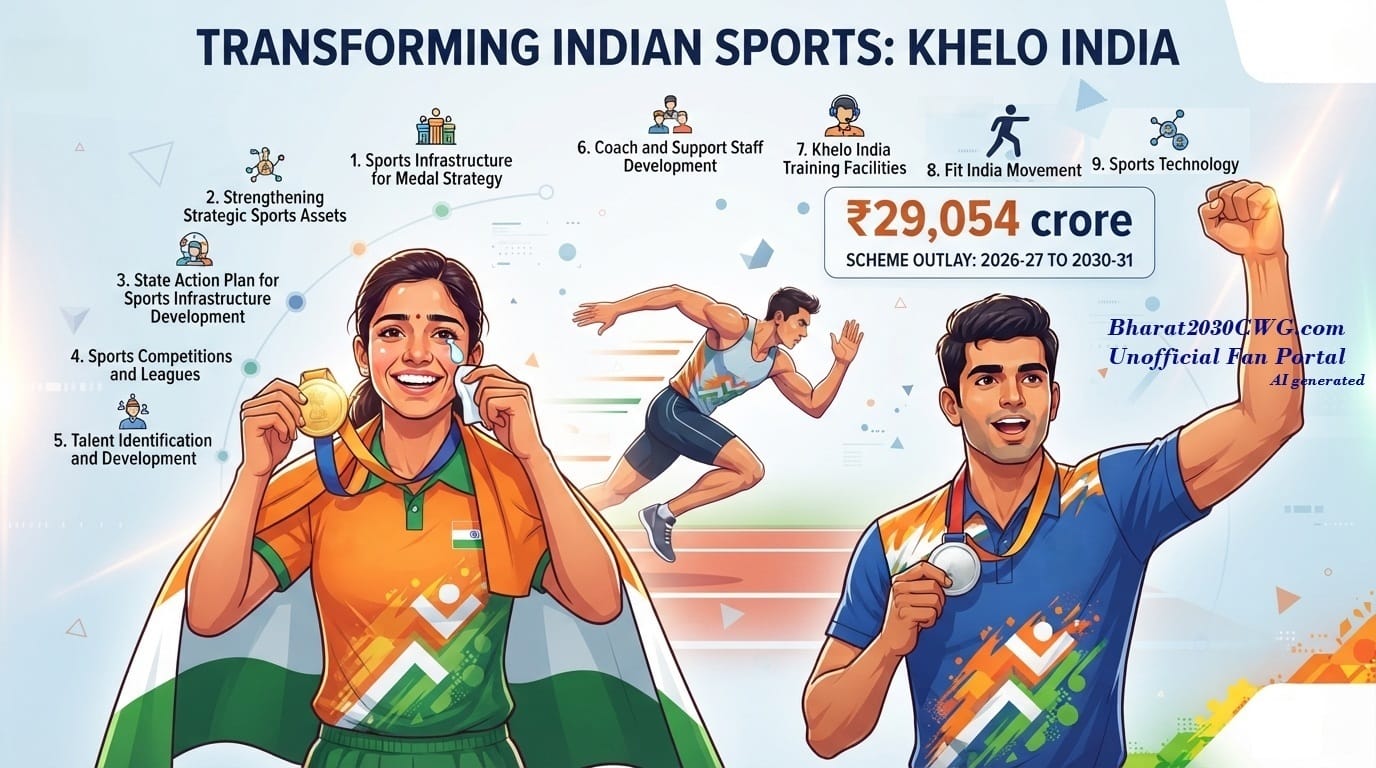
The Ministry of Youth Affairs and Sports has formally notified the next phase of the Khelo India Scheme, covering the five-year period from 2026-27 to 2030-31. The notification, issued by the Department of Sports on 10 August 2026 and published in the Gazette of India, sets out an approved outlay of ₹29,054 crore and restructures the scheme around nine components spanning infrastructure, talent development, coaching, competitions, and sports technology.
The scheme was cleared by the Union Cabinet and is stated to be effective immediately.
Background and stated vision
According to the notification, the scheme is framed as being aligned with the Khelo Bharat Niti 2025 and the National Education Policy 2020. Its stated vision is "to transform India's Sports Landscap," with an emphasis on building an integrated pathway from grassroots participation to elite performance, supported by a nationwide network of training facilities, structured coach development, and the use of sports science and technology. It also prioritises targeted support for women, para-athletes, indigenous sports, and regions that remain underserved by sporting facilities.
The nine components
The scheme document lists the following components, each with its own five-year financial allocation:
Sports Infrastructure for Medal Strategy — ₹4,866 crore. Covers greenfield and brownfield projects such as fields of play, hostels, strength and conditioning facilities, and sports science centres, prioritised by medal potential and regional strengths, alongside dedicated operations-and-maintenance funding.
Strengthening Strategic Sports Assets — ₹4,963 crore. Focused on modernising existing Sports Authority of India (SAI) centres and other institutions such as the Army Sports Institute, and on building new high-performance centres with advanced sports science and medicine units.
State Action Plan for Sports Infrastructure Development — ₹1,965 crore (₹1,400 crore Central share, ₹565 crore State/UT share). A centrally sponsored component intended to extend infrastructure to states and regions outside the primary national medal strategy. Funding follows a tiered formula: 60:40 for general-category states, 90:10 for North-Eastern and Himalayan states, and 100 percent Central funding for Union Territories.
Sports Competitions and Leagues — ₹2,358 crore. Builds on the Khelo India Games, which have seen participation of more than 60,000 athletes across 24 editions in over 20 states and UTs since 2017-18. The component adds a new layer of leagues at school, university, regional, and sport-specific levels. It also includes the ASMITA Leagues to expand women’s participation, a “Sports for Peace and Development” initiative for border and conflict-affected areas, and dedicated support for indigenous, tribal, and para-sports.
Talent Identification and Development (TID) — ₹2,407 crore. Introduces a standardised, science-based national framework to replace fragmented state- and federation-level protocols. It defines two athlete categories — Khelo India Athletes (KIA) and Emerging Khelo India Athletes (E-KIA) — progressing through four tiers: Foundation, Grassroots, Intermediate, and Elite. Identification will run through Talent Scouts, Talent Identification Zonal Committees, and sport-specific national committees, supported by performance-linked Out-of-Pocket Allowances.
Coach and Support Staff Development — ₹748 crore. Establishes a National Coach Accreditation Board under SAI with a four-tier certification system — community, developmental, performance, and elite/high-performance coaches — along with a digital platform (e-Khel Paathshala) for standardised training and a national registry of certifications. A Human Resource Development in Sports sub-component funds training, research, and skilling not covered under other schemes.
Khelo India Training Facilities — ₹10,586 crore. The largest single allocation, at roughly 37 percent of the outlay. It creates a tiered training ecosystem: Olympic Training Centres at the elite level; SAI Training Centres, Khelo India Centres of Excellence, and accredited academies at the intermediate level; and Khelo India Utkrishta Vidyalayas, Feeder Schools, and Centres at the grassroots level, integrating sports with school education.
Fit India Movement — ₹300 crore. Continues the mass-participation initiative launched in August 2019, working through fitness clubs, resident welfare associations, schools, colleges, and panchayats, with continued investment in the Fit India App.
Sports Technology — ₹302 crore. Funds a "Khelo India Digital Ecosystem," including a National Sports Repository System, an Athlete Management System, a Game Management System, and a Federation Management System, intended to support centralised data, AI-assisted talent analytics, and public dashboards.
Administrative expenses — covering human resource support, capacity building, anti-doping initiatives, and evaluation — account for a further ₹559 crore, about 2 percent of the total outlay.
Financial breakdown
Of the total ₹29,054 crore, ₹28,489 crore is the Central government's share and ₹565 crore is the states' contribution, the latter tied specifically to the State Action Plan component. Year-wise Central allocations rise from ₹3,173 crore in 2026-27 to a peak of ₹6,829 crore in 2029-30, before easing to ₹5,572 crore in the final year, 2030-31. Of the total, ₹16,082 crore is classified as recurring expenditure and ₹12,407 crore as non-recurring (largely capital) expenditure.
Governance and approval structure
The scheme will be steered by a National Executive Council (NEC), chaired by the Union Minister of Youth Affairs and Sports, described in the notification as the scheme's "highest policymaking body." Project proposals will first be appraised by a Project Appraisal Committee (PAC), which submits recommendations to a Departmental Project Approval Committee (DPAC) chaired by the Secretary (Sports) for approval and monitoring.
States and Union Territories may also set up their own Monitoring Committees, chaired by the state's Principal Secretary or Secretary for Sports and Youth Affairs (or a university Registrar/Dean, where relevant), with a representative from SAI or the Ministry as a member.
The Department of Sports has been designated as the implementing authority, with powers to issue operational guidelines, circulars, and directives as needed. The notification also permits the Ministry to reallocate funds between the scheme's nine components, subject to Department of Expenditure guidelines, and provides for periodic, mid-term, and post-implementation evaluation by an independent third-party agency.
Looking Ahead
Arriving nearly a year after Ahmedabad was confirmed as the host city for the 2030 Commonwealth Games, the scheme also positions itself in support of India’s longer-term aspiration to host the 2036 Olympic Games.
Source: YAS - Khelo India Scheme 2026
Follow us on X | Instagram for live updates.
📋 Related Resources for CWG 2030 Ahmedabad
Did you enjoy this article?
Disclaimer: The information presented in this article has been gathered from news articles and various internet sources with AI assistance. While we strive for accuracy, we cannot guarantee the completeness or correctness of all information. Reader discretion is advised. For official information, please refer to the Commonwealth Games Federation and official CWG 2030 sources.
💬 Comments Coming Soon
We're setting up our community discussion feature. Stay tuned!