Official Sports Governing Bodies in India: Full Guide
Published on Jul 6, 2026Updated on Jul 12, 202610 min readBy The Bharat 2030 CWG Team
Official Sports Governing Bodies in India: A complete guide to Sports Governance, CWG 2026 & Ahmedabad 2030 and National Sports Policy (NSP) 2025
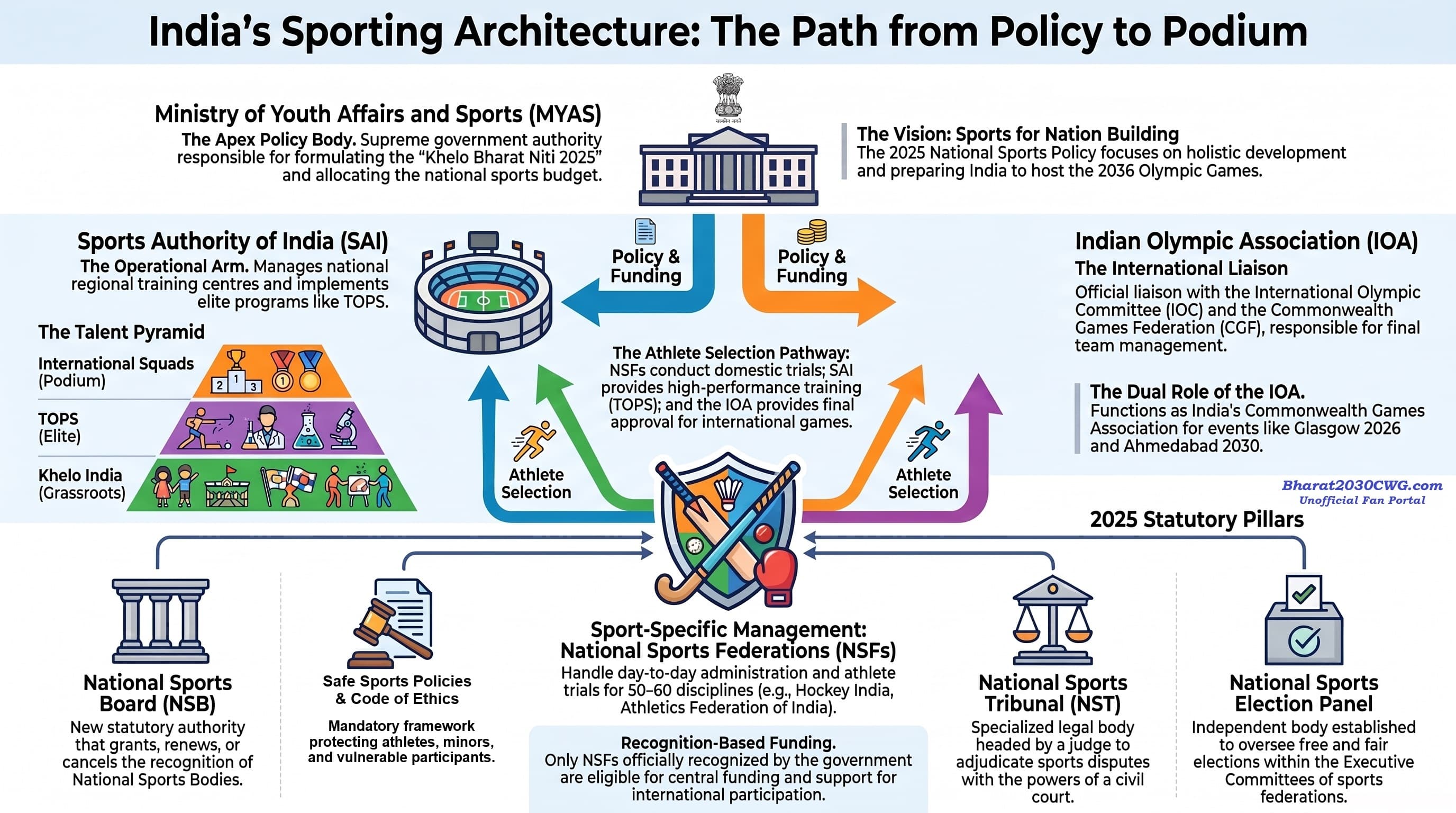
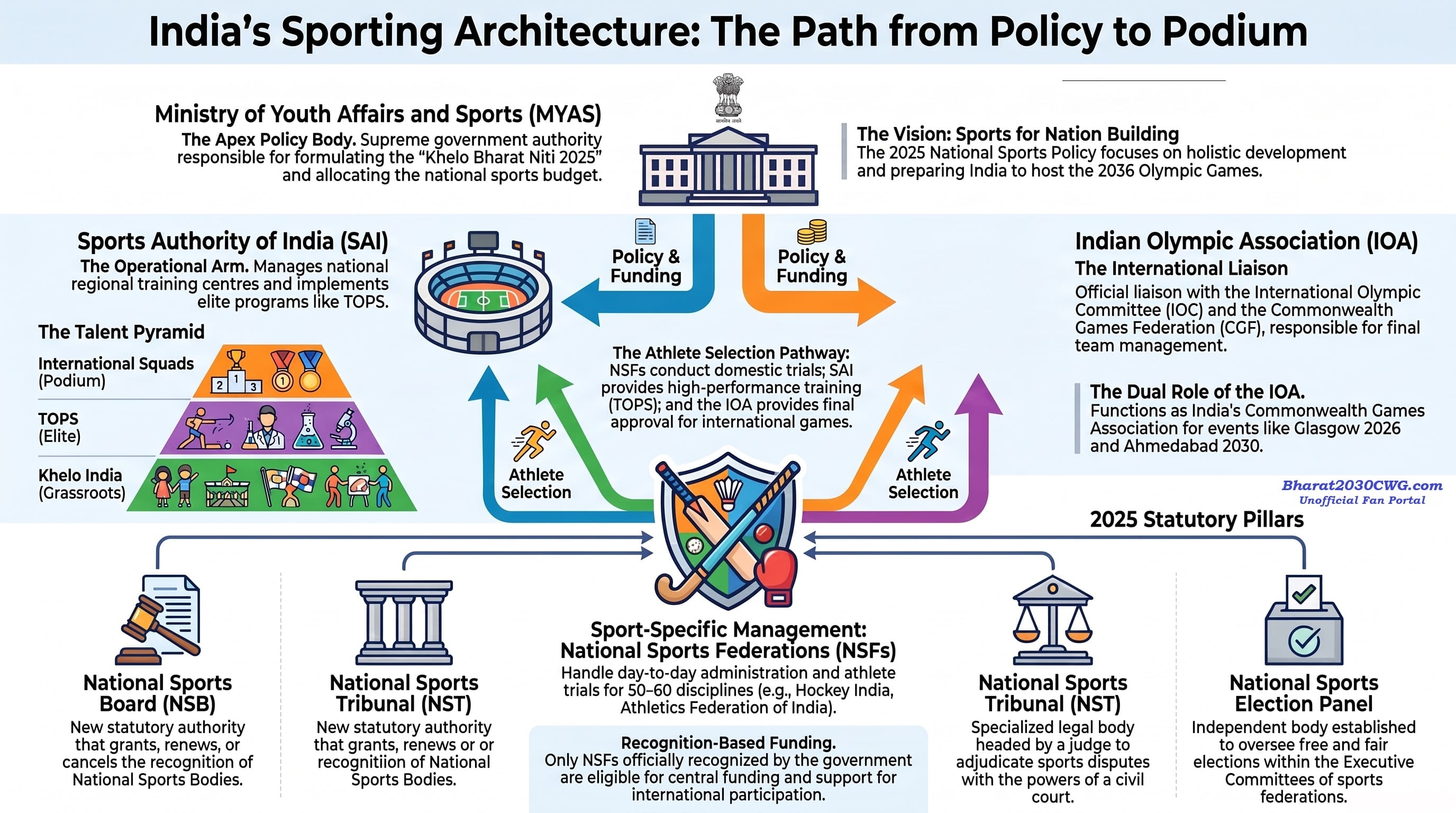
Ever wondered who selects the Indian athletes for the Commonwealth Games, funds their training or is responsible for preparing Ahmedabad for the 2030 edition? Indian sports operate through a well-defined structure involving the Central Government, autonomous bodies, and sport-specific federations. The Ministry of Youth Affairs and Sports (MYAS) serves as the apex policy-making body, while implementation happens through specialized agencies like the Sports Authority of India (SAI) and National Sports Federations (NSFs). This framework supports grassroots development, elite athlete training, infrastructure, and India's participation in international events like Glasgow 2026 and Ahmedabad 2030.
This guide explains the key organisations that shape Indian sports today, from grassroots development to international participation. Whether you are following India's campaign at Glasgow 2026 or looking ahead to Ahmedabad 2030, understanding these bodies will give you better context behind the squads, performances, and preparations.
Role: The primary government ministry responsible for formulating sports policies, recognizing NSFs, allocating funds, and promoting sports and youth development. It oversees two departments: Department of Sports and Department of Youth Affairs.
Key Initiatives: Khelo India (talent identification and development across age groups), National Sports Awards (e.g., Major Dhyan Chand Khel Ratna, Arjuna Award), and infrastructure schemes. In 2025, the Cabinet approved a new National Sports Policy (NSP) 2025 [Khelo Bharat Niti -2025], replacing the 2001 policy. The vision of the Khelo Bharat Niti-2025 is "Sports for Nation Building – Harness the Power of Sports for Nation's Holistic Development".
Ministry Leadership:
Union Minister (Cabinet Minister): Dr. Mansukh Mandaviya
Minister of State: Smt. Raksha Nikhil Khadse
Website: yas.gov.in
Establishment: 1984, as a legacy of the 1982 IXth Asian Games in New Delhi.
Role: Autonomous body under MYAS that manages national sports infrastructure, regional training centers, and talent nurturing. It implements many Khelo India schemes and focuses on high-performance sports.
Target Olympic Podium Scheme (TOPS): SAI's flagship elite-athlete program, and the one most directly relevant to Commonwealth Games / Olympic medal hopefuls. MYAS launched TOPS in September 2014 to fast-track athletes with realistic podium potential, backing them with foreign training exposure, international competition costs, equipment, dedicated coaching camps, and a monthly stipend. The programme currently backs 98 athletes in its Core Group (spanning 13 sports disciplines plus the men's and women's Hockey teams) and 165 athletes in its Development Group (across 12 disciplines). TOPS has expanded responsibility (now covering 27 sports click here).
Website: sportsauthorityofindia.nic.in
The Ministry of Youth Affairs and Sports (MYAS) and Sports Authority of India (SAI) are the two most important organisations in Indian sports. Here's how they differ:
Aspect | Ministry of Youth Affairs & Sports (MYAS) | Sports Authority of India (SAI) |
Status | Central Government Ministry (Policy Making) | Autonomous Body under MYAS (Implementation) |
Main Role | Policy formulation, funding allocation, and overall governance | Day-to-day implementation, training, and infrastructure management |
Key Responsibilities | • National Sports Policy • Recognition of National Sports Federations (NSFs) • Budget allocation • National Sports Awards • Coordination with State Governments & International Bodies | • Runs Khelo India & TOPS schemes • Manages national training centres & academies • Talent identification & athlete support • Infrastructure development (stadia, regional centres) |
Relevance to CWG 2026 & 2030 | Overall coordination & funding for India's participation and hosting | Athlete preparation, training camps, and venue readiness |
Leadership | Union Minister (Dr. Mansukh Mandaviya) | Director General (appointed by Government) |
Website |
Note: SAI functions as the operational arm of MYAS. Most athletes and fans interact more with SAI programs (Khelo India, TOPS), while MYAS sets the broader vision and policies.
Role: Recognized by the International Olympic Committee (IOC), the IOA is India's national Olympic committee, responsible for India's participation in the Olympics, Asian Games, and other multi-sport events, and for coordinating with NSFs on athlete selection. The IOA also functions as India's Commonwealth Games Association, making it the country's official liaison with the Commonwealth Games Federation (CGF), it isn't a separate body from the IOA, just a second hat the same organisation wears.
Establishment: 1927.
Leadership: PT Usha is the current President of the IOA, the first woman and first Olympian to hold the post.
Website: olympic.ind.in
These are the sport-specific governing bodies recognized under the new statutory framework (see below), numbering roughly 50–60. They handle day-to-day administration, domestic competitions, talent development, and international participation for their respective sports. Only recognized NSFs are eligible for government funding and support.
Examples of Major NSFs (partial list based on official recognitions):
Athletics: Athletics Federation of India
Badminton: Badminton Association of India
Football: All India Football Federation (AIFF)
Hockey: Hockey India
Swimming: Swimming Federation of India
Boxing: Boxing Federation of India
Others include Archery Association of India, Basketball Federation of India, and federations for Kabaddi, Chess, etc.
Cricket: Board of Control for Cricket in India (BCCI), a notable exception; functionally autonomous and outside standard NSF funding/recognition arrangements, though it still coordinates with the government on matters like international team clearances and visa protocols for overseas tours.
Full updated lists of recognized NSFs are available on the MYAS website (yas.gov.in and National Sports Federation) with annual recognitions. Re-organisation of NSBs are ongoing (click here).
This is the most significant governance change in recent years, superseding any earlier framing of it as a pending reform rather than settled law.
Status: The Bill was introduced in the Lok Sabha in July 2025, passed by the Lok Sabha on 11 August 2025 and the Rajya Sabha on 12 August 2025, and received Presidential assent on 18 August 2025. It is now the National Sports Governance Act, 2025 — India's first parliamentary law comprehensively regulating sports governance, replacing the non-binding National Sports Development Code of India, 2011.
The Act establishes:
National Sports Bodies, namely the National Olympic Committee, the National Paralympic Committee, a National Sports Federation for each designated sport and a Regional Sports Federation for each designated sport
A National Sports Board (NSB), the statutory authority that grants, renews, suspends, or cancels recognition of national sports bodies. Only NSB-recognized bodies can receive central government funding.
A National Sports Tribunal (NST) to adjudicate sports-related disputes, with a chairperson (Supreme Court or High Court judge) and two expert members. The Tribunal has civil court powers, and its decisions are executable as decrees. Appeals lie to the Supreme Court unless international statutes require arbitration through the Court of Arbitration for Sport.
A National Sports Election Panel, to oversee the conduct of free and fair elections to the Executive Committee and the Athletes Committee of the National Sports Bodies.
Mandatory Safe Sports Policies and Codes of Ethics for every national sports body, aimed at protecting women, minors, and other vulnerable participants.
The Act is explicitly framed by the government as preparation for India's 2036 Olympic hosting ambitions and for aligning Indian sports governance with the Olympic and Commonwealth Charter, connecting NSF-level reforms directly to the bigger 2030/2036 hosting story, rather than being background civics on its own.
National Anti-Doping Agency (NADA): Implements anti-doping rules and testing under the National Anti-Doping Act, 2022, which was itself amended in August 2025 alongside the Governance Act to align with updated international anti-doping definitions.
Lakshmibai National Institute of Physical Education (LNIPE): Premier institution for sports education, coaching, and research (Gwalior, with a campus in Thiruvananthapuram).
Netaji Subhas National Institute of Sports (NSNIS), Patiala: Key training hub.
State Sports Bodies: Each state runs its own sports department and coordinates with national bodies for grassroots and state-level events. Gujarat's is currently the most active given Amdavad 2030 preparations.
The upcoming Centenary Commonwealth Games in Ahmedabad 2030 is a joint effort between the Central and Gujarat Governments. Here’s how the major organisations are involved:
Ministry of Youth Affairs and Sports (MYAS): Overall policy, funding, and coordination with the Commonwealth Games Federation (CGF). It is the nodal ministry for India’s hosting responsibilities.
Sports Authority of India (SAI): Infrastructure development, athlete preparation through Khelo India and TOPS schemes, and management of training camps for 2030-bound athletes.
Indian Olympic Association (IOA) / Commonwealth Games Association of India: Official liaison with the CGF, athlete selection, and team management for the Games.
Government of Gujarat & Ahmedabad 2030 Organising Committee: Day-to-day delivery, venue construction/renovation (Narendra Modi Stadium, Sardar Vallabhbhai Patel Sports Enclave, etc.), and state-level coordination.
National Sports Federations (NSFs): Sport-specific preparation, domestic trials, and selection of athletes for the 2030 squad.
The National Sports Governance Act 2025 plays a crucial role here by ensuring transparent governance and accountability across all these bodies, a key requirement from the Commonwealth Games Federation for successful hosting.
Khelo India serves as the foundational grassroots and talent identification programme under the Ministry of Youth Affairs and Sports (MYAS) and is implemented by the Sports Authority of India (SAI). Launched to promote mass participation and early talent spotting, it identifies promising athletes across age groups (U-8 to senior) through school/college competitions, Khelo India Youth Games, University Games, and talent searches in rural and urban areas. Selected athletes receive scholarships, training at SAI centres, coaching, equipment, and competition exposure.
The pathway to elite level is structured: Outstanding performers from Khelo India schemes (including para-sports) are scouted and fast-tracked into the Target Olympic Podium Scheme (TOPS). TOPS provides high-performance support — foreign training, international competitions, scientific backing, dedicated coaches, and stipends — primarily for athletes with podium potential in Olympic/Commonwealth/Asian Games disciplines.
International selection is managed collaboratively: NSFs conduct domestic trials and national championships (often featuring Khelo India and TOPS athletes), with final squads approved by the Indian Olympic Association (IOA) for multi-sport events like the Commonwealth Games. This creates a clear talent pyramid — from mass participation under Khelo India to elite grooming under TOPS and NSF-led selection — ensuring a steady supply of athletes for India's campaigns at Glasgow 2026, Ahmedabad 2030, and beyond.
This integrated system strengthens depth in the squad while aligning with the Khelo Bharat Niti 2025 vision of holistic sports development.
Ahmedabad 2030 is widely seen as a crucial dry run for India's ambition to host the 2036 Summer Olympics and Paralympics. India submitted a formal Letter of Intent to the IOC in October 2024 naming Ahmedabad as the proposed host city and is currently in the IOC's Continuous Dialogue phase, with a host city expected to be selected by mid-2029.
Prime Minister Narendra Modi has strongly backed the bid, with India's pitch including the potential addition of regionally significant sports like cricket, kabaddi, and kho kho. Success in delivering the 2030 Commonwealth Games—particularly on governance, anti-doping, and infrastructure—will be key evidence to the IOC amid competition from countries such as Türkiye, Indonesia, and South Korea.
Understanding this structure, MYAS setting policy, SAI and the NSFs doing the on-ground work, the IOA managing India's presence on the international stage, and the new National Sports Governance Act binding it all together, is the key to following India's sporting story over the next decade with real context, rather than just headlines.
That story has two connected chapters still to play out. First, Glasgow 2026, where India's squad carries both medal ambitions and, more quietly, a dress rehearsal for hosting duties. Then Ahmedabad 2030, the Centenary Commonwealth Games, where India moves from competitor to host for the first time since Delhi 2010 and where a well-run Games could become the strongest argument yet for India 2036.
We'll keep updating this guide as the National Sports Board becomes operational, as NSFs go through re-recognition under the new Act, and as India's Olympic bid moves through the IOC's Strategic Dialogue stage. Bookmark this page, and follow along with our Glasgow 2026 and Amdavad 2030 coverage for the latest.
Last Updated on 07-07-2026
For hindi version - Click here
Follow us on X | Instagram for more updates.
Planning for the big games? Check out our unofficial guides:
Ahmedabad 2030 Host City Guide – Everything we know about the host city.
Venues Master Plan – Explore the proposed stadiums and arenas.
Tickets Info – Stay updated on ticket releases and travel tips.
Disclaimer: The information presented in this article has been gathered from news articles and various internet sources with AI assistance. While we strive for accuracy, we cannot guarantee the completeness or correctness of all information. Reader discretion is advised. For official information, please refer to the Commonwealth Games Federation and official CWG 2030 sources.
We're setting up our community discussion feature. Stay tuned!
MYAS handles policy, funding, and governance. SAI (Sports Authority of India) is its operational arm responsible for implementation — it manages training centers, infrastructure, talent development, and programs like TOPS (Target Olympic Podium Scheme) for elite athletes.
TOPS is SAI's flagship program that supports medal hopefuls for the Olympics, Asian Games, and Commonwealth Games with foreign training, coaching, equipment, and a monthly stipend. It currently backs 98 athletes in its Core Group and 165 in its Development Group, and was expanded in May 2026 to cover all 27 Olympic sports disciplines.
The Indian Olympic Association (IOA) acts as India’s Commonwealth Games Association. It coordinates with National Sports Federations (NSFs) for athlete selection and liaises with the Commonwealth Games Federation.
NSFs are sport-specific governing bodies (e.g., Athletics Federation of India, AIFF for football) that manage domestic competitions, talent development, and international participation. Only recognized NSFs receive government funding.
It is a new law that regulates sports governance in India. It establishes a National Sports Board for recognition of bodies, a National Sports Tribunal for dispute resolution, and mandates fair elections, ethics codes, and safe sports policies. It aims to strengthen governance ahead of Ahmedabad 2030 and the 2036 Olympics bid.
MYAS: yas.gov.in SAI: sportsauthorityofindia.nic.in IOA: olympic.ind.in