Glasgow 2026 Commonwealth Games : Overview
यह लेख हिंदी में उपलब्ध नहीं है (Content Un-translated)
क्षमा करें, यह आर्टिकल अभी केवल अंग्रेजी में उपलब्ध है। हम जल्द ही इसका अनुवाद उपलब्ध कराने के लिए काम कर रहे हैं।
Published on Jun 13, 2026Updated on Jun 14, 20264 min readBy The Bharat 2030 CWG Team
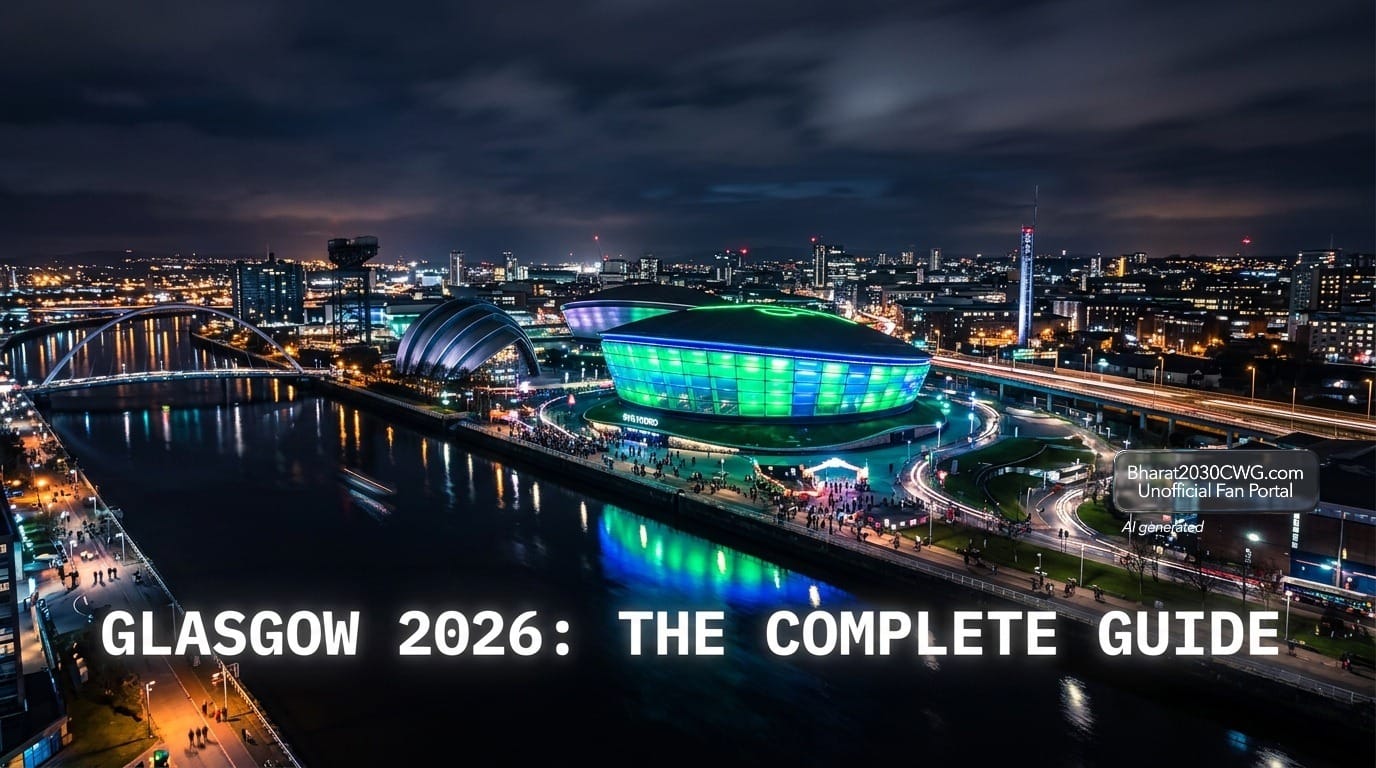
Glasgow 2026 Commonwealth Games: All you need to know about the Glasgow 2026 venues, streamlined sports schedule, and key medal dates for Indian fans.
Overview
The XXIII Commonwealth Games (Glasgow 2026) will take place from 23 July to 2 August 2026 in Glasgow, Scotland. This will be Glasgow’s second time hosting the Games after the highly successful 2014 edition and the fourth time Scotland has hosted the event overall.
Originally awarded to Australia, the Games were relocated to Glasgow after Australia withdrew due to budget constraints. As a result, Glasgow 2026 has been designed as a deliberately compact and cost-conscious edition. The event will feature a core programme of 10 sports (plus para-sports) concentrated within an eight-mile corridor of the city. Around 3,000 athletes from 74 nations and territories are expected to compete, supported by roughly 3,000 volunteers.
Athletes and support staff will stay in hotel accommodation rather than a traditional athletes’ village.
Host City: Glasgow
Glasgow, Scotland’s largest city, boasts rich Victorian architecture, a vibrant cultural scene, and a strong sporting heritage. By reusing existing world-class venues from the 2014 Games and the 2018 European Championships, organisers have kept costs down while ensuring excellent accessibility for athletes and spectators.
Venues
All major competition venues are located close together:
Scotstoun Stadium – Athletics & Para Athletics
Tollcross International Swimming Centre – Swimming & Para Swimming
Emirates Arena (including Sir Chris Hoy Velodrome) – Track Cycling & Para Track Cycling, Artistic Gymnastics
Scottish Event Campus (SEC) – Netball, Weightlifting & Para Powerlifting, Boxing, Judo, Bowls & Para Bowls, 3x3 Basketball & 3x3 Wheelchair Basketball
The Hydro (part of the SEC complex) will host the Opening Ceremony.
Sports Programme
Glasgow 2026 features a leaner programme compared to recent editions. The confirmed sports are:
Athletics & Para Athletics
Swimming & Para Swimming
Artistic Gymnastics
Track Cycling & Para Track Cycling
Netball
Weightlifting & Para Powerlifting
Boxing
Judo
Bowls & Para Bowls
3x3 Basketball & 3x3 Wheelchair Basketball
Notably absent are several traditional Indian strengths such as wrestling, badminton, hockey, shooting, cricket, and table tennis.
Competition Schedule & Key Dates
Here is the high-level competition window for each sport:
Sport | Competition Window | Key Indian Focus Area |
|---|---|---|
Swimming | 24 – 29 July | Early pool sessions |
Artistic Gymnastics | 24 – 28 July | Apparatus finals |
3x3 Basketball | 24 – 29 July | Group stages & finals |
Boxing | 24 – 29 July & 31 July – 1 Aug | Prelims to medal bouts |
Lawn Bowls | 24 July – 2 August | Building on 2022 success |
Weightlifting | 26 – 30 July | Early medal opportunities |
Athletics | 27 July – 1 August | Javelin, triple jump, relays |
Track Cycling | 30 July – 2 August | Velodrome sprints |
Judo | 31 July – 2 August | Knockout brackets |
Netball | 25 July – 2 August | Full tournament |
Major Calendar Highlights
23 July – Opening Ceremony at The Hydro
24 July – First full day of competition (Swimming, Gymnastics, Boxing, Bowls, 3x3 Basketball)
26 July – Weightlifting begins (strong medal prospects for India)
27 July – Athletics starts at Scotstoun Stadium
1 August (Super Saturday) – Busiest day of the Games with ~44 gold medals, including 19 Athletics finals, 14 Boxing finals, plus Judo and Track Cycling
2 August – Closing Ceremony with the final 15 medal events
1 August stands out as the biggest day, featuring the Men’s Javelin Throw final, Mixed 4x400m relay final, and multiple other high-profile events.
India at Glasgow 2026
India’s campaign will look significantly different from Birmingham 2022, where the country won 61 medals. Nearly half of those medals came from sports omitted from the 2026 programme (wrestling, badminton, table tennis, hockey, and cricket).
India’s medal hopes will rest primarily on:
Weightlifting & Para Powerlifting – A consistent medal-contributing discipline for India in recent Commonwealth Games, led by stars like Mirabai Chanu. Early sessions (26–27 July) will be crucial.
Athletics & Para Athletics – Headlined by stars such as Neeraj Chopra. The Men’s Javelin and relay events on 1 August are major highlights.
Boxing – Consistent performers who have delivered medals in previous Games.
Lawn Bowls – Looking to repeat the historic success of 2022.
Judo – Short, high-intensity window at the end of the Games.
While the overall medal target may be more modest, a focused squad in these disciplines could still deliver strong individual performances and build momentum toward Ahmedabad 2030.
Viewing Guide for Indian Fans
Glasgow is on British Summer Time (BST).
Glasgow time (BST) + 4.5h = IST.
Most key finals will air in the evening and late night in India, perfect for weekend viewing.
Note:
Individual sport date ranges in the table above are drawn from the official session schedule framework and cross-checked against confirmed anchor dates (Athletics, Swimming, Track Cycling, Bowls). Minor shifts are possible, always confirm exact dates at glasgow2026.com closer to the Games.
For the full day-by-day schedule and latest updates, visit the official website: glasgow2026.com.
Follow us on X | Instagram for more updates.
📋 Related Fan Resources
Planning for the big games? Check out our unofficial guides:
Ahmedabad 2030 Host City Guide – Everything we know about the host city.
Venues Master Plan – Explore the proposed stadiums and arenas.
Tickets Info – Stay updated on ticket releases and travel tips.
Did you enjoy this article?
Disclaimer: The information presented in this article has been gathered from news articles and various internet sources with AI assistance. While we strive for accuracy, we cannot guarantee the completeness or correctness of all information. Reader discretion is advised. For official information, please refer to the Commonwealth Games Federation and official CWG 2030 sources.
Previous
CWG 2030 Weekly Roundup: 01-07 June, 2026 Updates
Next
India's Athletics Stars Set to Conquer Glasgow 2026!
💬 Comments Coming Soon
We're setting up our community discussion feature. Stay tuned!